what do you need to know to learn trigonometry
Introduction to Trigonometry
Trigonometry (from Greek trigonon "triangle" + metron "mensurate")
Want to learn Trigonometry? Hither is a quick summary.
Follow the links for more, or go to Trigonometry Index
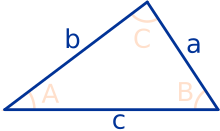 | Trigonometry ... is all near triangles. |
Trigonometry helps usa find angles and distances, and is used a lot in science, engineering science, video games, and more!
Correct-Angled Triangle
The triangle of most involvement is the right-angled triangle. The right angle is shown past the picayune box in the corner:
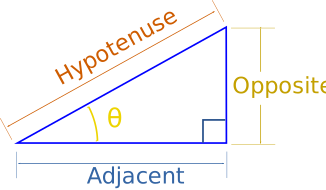
Some other angle is ofttimes labeled θ, and the three sides are and then called:
- Adjacent: next (next to) the angle θ
- Opposite: opposite the bending θ
- and the longest side is the Hypotenuse
Why a Correct-Angled Triangle?
Why is this triangle so important?
Imagine we tin can measure along and upward but want to know the direct altitude and angle:
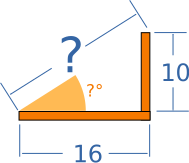
Trigonometry can find that missing angle and distance.
Or maybe we have a distance and angle and need to "plot the dot" along and upwards:
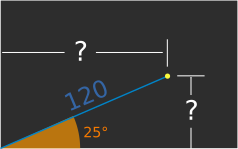
Questions like these are mutual in engineering, computer animation and more than.
And trigonometry gives the answers!
Sine, Cosine and Tangent
The master functions in trigonometry are Sine, Cosine and Tangent
They are simply one side of a right-angled triangle divided by another.
For any angle " θ ":
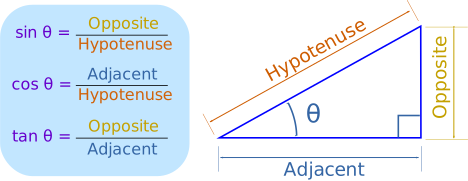
(Sine, Cosine and Tangent are often abbreviated to sin, cos and tan.)
Instance: What is the sine of 35°?
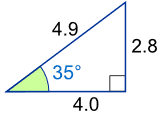
Using this triangle (lengths are just to 1 decimal place):
sin(35°) = Opposite Hypotenuse = ii.8 4.nine = 0.57...
The triangle could be larger, smaller or turned around, but that bending will e'er have that ratio.
Calculators accept sin, cos and tan to assistance us, so allow'south see how to use them:
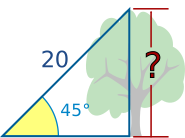
Example: How Tall is The Tree?
We can't reach the top of the tree, so we walk abroad and measure an angle (using a protractor) and altitude (using a laser):
- We know the Hypotenuse
- And we want to know the Opposite
Sine is the ratio of Opposite / Hypotenuse:
sin(45°) = Reverse Hypotenuse
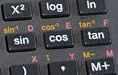
Go a figurer, type in "45", then the "sin" key:
sin(45°) = 0.7071...
What does the 0.7071... hateful? It is the ratio of the side lengths, so the Opposite is about 0.7071 times as long as the Hypotenuse.
We tin now put 0.7071... in place of sin(45°):
0.7071... = Contrary Hypotenuse
And we also know the hypotenuse is 20:
0.7071... = Contrary 20
To solve, beginning multiply both sides past 20:
20 × 0.7071... = Contrary
Finally:
Reverse = 14.14m (to 2 decimals)
Example: How Tall is The Tree?
Get-go with: sin(45°) = Contrary Hypotenuse
Nosotros know: 0.7071... = Reverse 20
Swap sides: Contrary twenty = 0.7071...
Multiply both sides by 20: Opposite = 0.7071... × xx
Calculate: Opposite = 14.fourteen
(to 2 decimals)
The tree is 14.14m tall
Effort Sin Cos and Tan
Play with this for a while (motility the mouse effectually) and get familiar with values of sine, cosine and tangent for dissimilar angles, such as 0°, 30°, 45°, 60° and 90°.
../algebra/images/circle-triangle.js
Too effort 120°, 135°, 180°, 240°, 270° etc, and detect that positions can be positive or negative by the rules of Cartesian coordinates, then the sine, cosine and tangent change betwixt positive and negative likewise.
So trigonometry is also about circles!
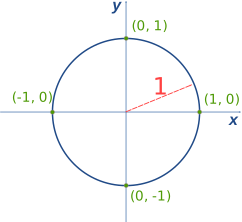
Unit Circle
What you just played with is the Unit of measurement Circle.
It is a circle with a radius of i with its center at 0.
Because the radius is ane, we can direct mensurate sine, cosine and tangent.
Hither nosotros see the sine function being made by the unit circle:
images/circle-sine.js
Notation: you tin can see the nice graphs made by sine, cosine and tangent.
Degrees and Radians
Angles can exist in Degrees or Radians. Here are some examples:
Repeating Pattern
Because the angle is rotating around and around the circle the Sine, Cosine and Tangent functions repeat once every full rotation (come across Amplitude, Flow, Phase Shift and Frequency).
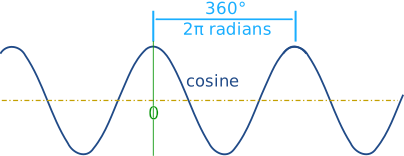
When nosotros want to calculate the office for an angle larger than a full rotation of 360° (2π radians) nosotros decrease as many full rotations as needed to bring it back below 360° (2π radians):
Example: what is the cosine of 370°?
370° is greater than 360° so let us subtract 360°
370° − 360° = 10°
cos(370°) = cos(10°) = 0.985 (to 3 decimal places)
And when the angle is less than zero, just add full rotations.
Example: what is the sine of −3 radians?
−3 is less than 0 so let us add together iiπ radians
−3 + 2π = −3 + 6.283... = 3.283... radians
sin(−three) = sin(3.283...) = −0.141 (to 3 decimal places)
Solving Triangles
Trigonometry is also useful for general triangles, not just right-angled ones .
It helps us in Solving Triangles. "Solving" means finding missing sides and angles.
We can likewise notice missing side lengths. The general rule is:
When we know any 3 of the sides or angles nosotros tin can observe the other 3
(except for the iii angles case)
See Solving Triangles for more details.
Other Functions (Cotangent, Secant, Cosecant)
Similar to Sine, Cosine and Tangent, at that place are 3 other trigonometric functions which are made by dividing one side by another:
| Cosecant Function: | csc(θ) = Hypotenuse / Opposite |
| Secant Function: | sec(θ) = Hypotenuse / Adjacent |
| Cotangent Function: | cot(θ) = Adjacent / Opposite |
Trigonometric and Triangle Identities
And as yous get better at Trigonometry you can acquire these:
Enjoy condign a triangle (and circle) expert!
Source: https://www.mathsisfun.com/algebra/trigonometry.html
0 Response to "what do you need to know to learn trigonometry"
Post a Comment